
ASTM C309 has long been (and continues to be) the industry standard for measuring the effectiveness of membrane forming compounds for curing concrete. However, the methodology used to prepare test specimens versus what we see today in the world of steel-troweled industrial floor slabs should be re-examined given the inherent differences associated with this specific finishing technique.
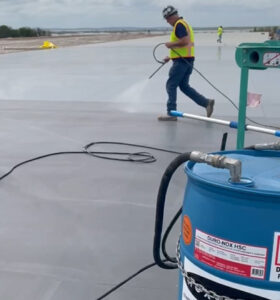
ASTM C309 and ASTM C156 were originally developed in order to establish a standardized testing method for curing of concrete with a membrane-forming curing compound by measuring moisture loss over a 72-hour period. The testing process begins with a concrete specimen that has been hand-finished according to ASTM C156, which states, “…using a wood float with one pass only…”. This specimen is then treated with the curing compound to be tested, and moisture loss is monitored over time.
It is important to note that, while this wood float method of finishing concrete was quite common when the test was developed, it simply does not reflect the surface density found in today’s industrial floor slabs that are finished using heavy ride-on trowel machines with steel blades. Independent testing has confirmed that by simply finishing concrete by hand with a steel trowel, the moisture retention characteristics are improved by 20% or more.
As finishing methods have improved and advanced, so have the chemicals used to improve and enhance the performance and durability of industrial floor slabs. Nox-Crete’s Duro-Nox line of water-based penetrating silicate densifiers have been used to densify, seal, harden, and dustproof steel-troweled industrial floor slabs for many years. They are able to achieve these results by capitalizing on the abundance of calcium-hydroxide (a byproduct of the cement hydration process), present in concrete. As the concrete begins to hydrate, microscopic pores (capillaries) open up on the surface. Silicate densifiers, when applied properly, penetrate these capillaries and react with the calcium-hydroxide present to form calcium silicate hydrate. Once this reaction has occurred, these tiny capillaries are now sealed, thereby producing a harder, denser, and more abrasion-resistant surface.
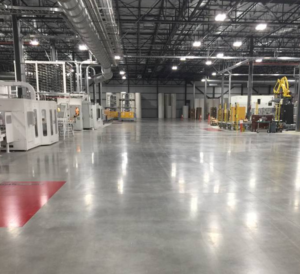
With this knowledge of how Duro-Nox densifiers function, we can now see how these chemical compounds will also act as an extremely capable curing compound when used in the specific instance of steel-troweled floor slabs. When silicate-based densifiers are applied immediately after troweling and finishing, this same reaction takes place, sealing off the capillaries and mitigating moisture loss, thus allowing the concrete ample time to cure properly. Even though silicate densifiers do not meet the criteria set forth in ASTM C309, as they are not membrane forming, they have been tested and confirmed to meet the water retention capabilities to effectively act as a curing compound when applied to steel troweled concrete slabs.
Due to this additional benefit, in recent years, Nox-Crete’s Duro-Nox and Duro-Nox LSC silicate densifiers have gained wide acceptance by numerous consultants, architects, and engineers throughout the world as effective and reliable curing compounds when applied to floor slabs finished with ride-on steel-bladed trowel machines.
With Nox-Crete’s most recent addition to its line of densifiers, Duro-Nox HSC, users will experience similar results in regards to curing properties, with even greater densification and hardening characteristics.
As times change, and technology advances, Nox-Crete remains dedicated to constantly raising the bar and providing innovative chemical solutions to concrete problems.
Click to download this Tilt-Up Construction Brief as a printable PDF.