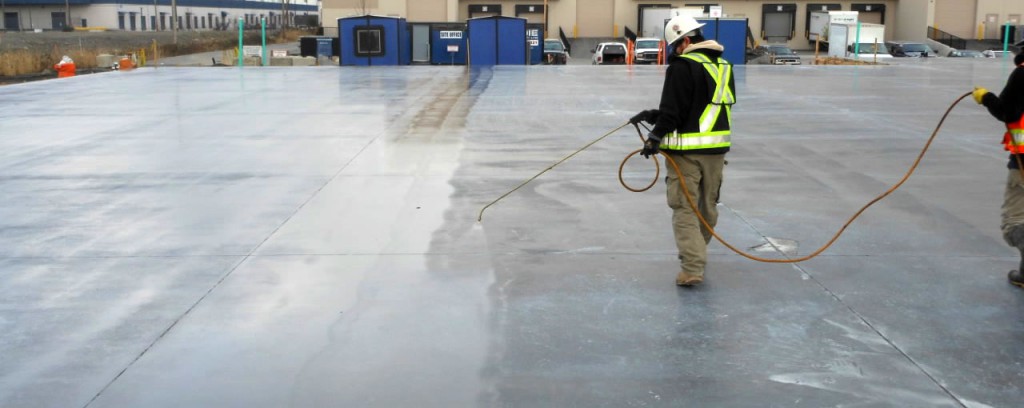
In the tilt-up industry, the term “osmotic effect” refers to the migration of water out of a tilt-up wall panel and into the casting slab during the critical panel concrete hydration process. A gradient is formed when wet concrete from a freshly placed wall panel is cast against a casting slab with lower water content. This results in water being drawn out of the panel concrete and into the casting slab through a process called osmosis. The moisture concentration difference between the wall panel and casting slab is directly related to the osmotic force or pressure attained to reach equilibrium between the two slabs. The “osmotic effect” is the incomplete hydration of the cement on the down side panel surface resulting from the loss of water due to migration into the casting slab through osmosis. Damage caused by the “osmotic effect” can range from minor panel surface defects such as dusting to complete skin pull-off, as deep as 1/16 inch in depth in the more severe cases.
Categories
Tags
- Acryl Pen
- Acrylic Sealer
- acrylic sealers
- aggies
- aro-peel
- ASTM C156
- ASTM C309
- ASTM C779
- ASTM D4060
- Bond breaker
- bond breaker residue
- Bondbreaker
- bondbreaker residue
- bondbreakers
- brick release
- Bridgeway
- BridgeWay Station
- Canada
- casting slab
- CEN/TS 14754
- Colored concrete
- Concrete
- concrete art
- Concrete Dust
- Concrete Floor
- concrete floors
- curing compound
- Deco-Strip
- Decorative Coating
- decorative concrete
- decorative sealer
- Densifier
- Dry-cast
- dry-cast release
- Duro Nox
- Duro-Color Dyes
- Flat Slab
- floor cleaner
- forklift
- form release
- Form Release Agents
- Hardener
- how to remove concrete buildup
- hydration
- kyle field
- Lewis and Clark
- liquid floor hardener
- Omaha
- pool
- Rachel Knigge-Bruce
- rebar
- rust
- sealer
- sealer removal
- Silane
- Silcoseal
- Silica Dust
- SIS-CEN/TS 14754
- slabs
- Sparkl-Seal
- Steel Trowel
- sweating slab
- Technical Bulletin
- texas a&m
- Textured Concrete
- Toronto